A therapist who once lost six years to a 10-14-hour-a-day gaming habit answers the question directly: yes, gaming addiction is real — and most people who have it don't realize it.
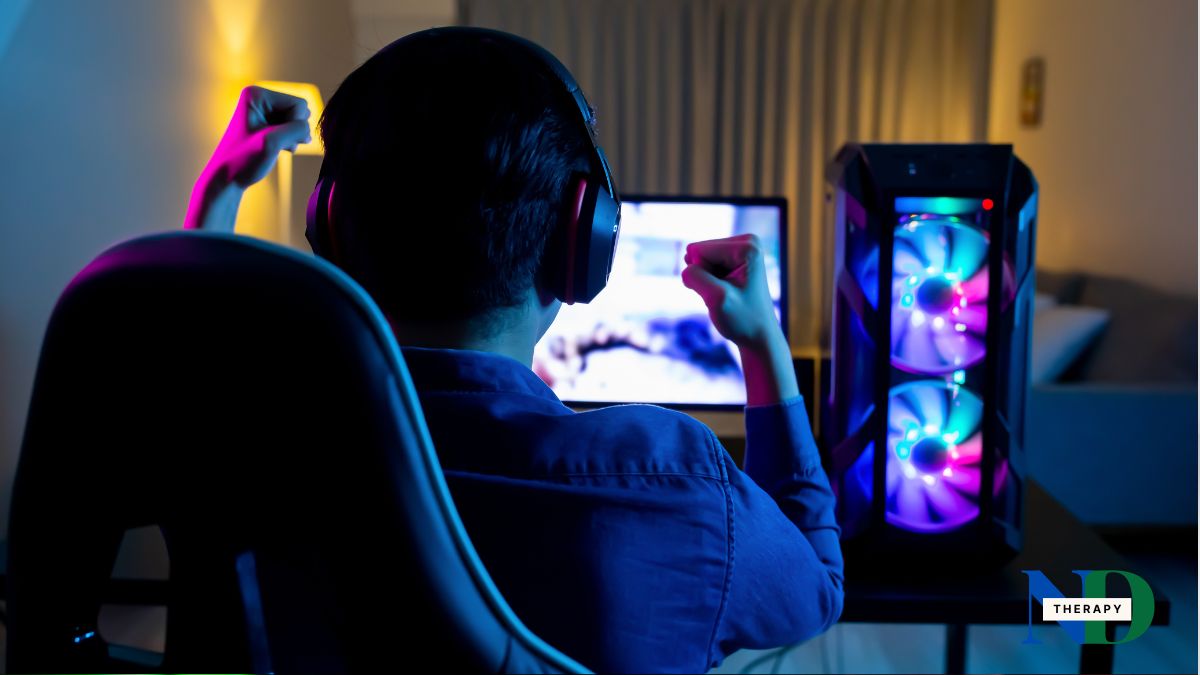
While growing up, I was what you would call a "video game nerd." I spent most of my free time playing video games, which were limited in the 80s and 90s. I remember making my first video game on the Commodore 64 when I was seven years old. I did not make a game, but copied code line by line into the computer. I remember in the 90s, while I was in high school, making levels in Doom and Doom II with my friend Ryan well into the night. I remember connecting with my friends over a dial-up modem, often angering my parents by taking over the phone line.
Once I entered my senior year of high school, I was introduced to online games. This was in 1997, almost two decades ago, when online gaming consisted of MUDS. MUDS were text-based games with no graphics, where you read everything and typed in commands. Because Internet speeds were extremely slow, graphics would take too long to load. One day, while on AOL, I found a MUD with thousands of live real-time players. I had never played a game with more than 5-10 players before, and the idea of playing with thousands of players was intriguing. I created an account and started to play. Little did I know my gaming addiction was born. For the next six years, I would spend 10-14 hours a day online playing this game while spending thousands of dollars. I would ignore friends, responsibilities, and halt my development into adulthood, all because of an online game.
Gaming addiction is real and a threat I have to guard myself against. I can easily become sucked into a game, finding ways to justify my time. With advances in technology, we have games in our pockets that we can play and interact with 24 hours a day, both personally and professionally. Gaming addiction is just as dangerous as drugs and alcohol; I have seen it destroy lives and relationships.
Anything Can Be Addictive
In the early days of psychology, addiction was mostly associated with drugs and alcohol. While I was in college, a professor once told me that addiction could only be chemical and that addictions to gambling or sex were not addictions at all. This is a view that many still hold. The problem with this theory is that behavioral addictions are chemical in nature, as the brain uses chemicals in all activities. All actions produce chemicals called neurotransmitters, which allow our brains to communicate and function. When I perform a task that feels good, chemicals are released in my brain, giving me feelings of pleasure. This task could be a chemical I ingested or an activity I performed. My brain does not care about the source; it only cares about the chemicals produced. While this is a simplistic way to describe how the brain works, it uses chemicals to communicate and function.
To answer the main question: Is gaming addiction real? The answer is a resounding yes. Specifically, the chemicals our brains release, and the stimulation games provide, are the addictive elements. Our brains do not care what the activity is, only that it is pleasurable. Over time, the brain will develop pathways that make it easier to perform certain activities. The more we game, the more our brains will expect it. If I did not play my game 10-12 hours a day, I would be in a bad mood, cranky, and obsessed over what I would do when I played later. I entered a withdrawal period, which does exist for behavioral addictions.
It's All About Stimulation
Our brains are not designed to function without stimulation. Stimulation comes from our five senses, some stronger than others. Our brains need stimulation to function and survive. Experiments have been done in sensory deprivation, where subjects were placed in sensory deprivation tanks for hours at a time. Over time, subjects would begin to hallucinate as their brains would begin to create stimulation. In truth, all addiction is about the stimulation of the brain. Without stimulation, addiction cannot exist.
As a society, we are overstimulated. Most people always have to be doing something, either talking, listening to music, or looking at their smartphones. Over time, our brains become addicted to the continuous state of stimulation. As we can now communicate and play games anywhere, gaming and Internet addiction rates are skyrocketing. As most people are becoming addicted to stimulation, it is becoming normal to be overstimulated.
As a result, most will not realize they are addicted to gaming or the Internet, as they will see their experience as a normal one that most share. If everyone does it, why must I stop? Most of us depend on technology to the point that we feel anxious or uneasy if we cannot access the Internet. AT&T's motto, "Keep Calm, Your Internet Is On," is a good benchmark on how important the Internet is to us. Without the Internet and continuous stimulation, we are lost.
That's the quiet danger: when overstimulation is the norm, addiction hides in plain sight, and the people who have it are often the last to see it. If any part of this has you wondering about your own use, my free Internet Addiction Self-Assessment measures it against the clinical markers of compulsion, with results on screen the moment you finish — a clear, private way to find out whether what feels "normal" has actually crossed the line. (If it's a teen or young adult you're wondering about instead, there's a parent version on the same page, built around what you observe in them.)
Why Are Games Addictive?
The games we have today are much more involved than in the past. Realistic graphics helped pave the way for near-realistic games. With the advancement of virtual reality, we will see gaming addiction increase dramatically. While realistic graphics are a part of gaming addiction, immersion is more important.
What is immersion? Immersion is entering the game in a way that the user feels they matter. Becoming part of a world is key to creating an addictive game. Players who feel their decisions matter and that they are important within the game will be more likely to return. Some of the most addictive games are MMORPGs, where users enter a virtual world with thousands of players who form groups. These games are highly immersive, as the player's actions matter to the group and to the game as a whole. When I was addicted to my online game, I greatly influenced events within the game. The game's creators themselves hated me because I often defeated them. I felt important in the world, and these feelings carried over into my real life. When I feel important in a game, I feel important overall. Gaming today often involves immersion in a world with real-life people you can interact with.
How Do We Stop Gaming Addiction?
To be honest, this is a difficult question to answer, as each addiction is unique to the person experiencing it. In a general sense, if you are addicted to games or your children are, you have to determine what you gain from the addiction. While simulation and immersion are important, there are needs behind driving the addiction. Social interaction is often needed, as many people are lonely in real life and have turned to the Internet to fill the void. Social anxiety is often present as many do not know how to communicate well with others in real life. Depression often exists where gaming and the Internet are coping skills to distract from the feelings of depression.
There is something behind the addiction driving it. This must be found and dealt with, or the addiction will return or change into something else. This is why it is important to determine what is gained from the addiction and what is missing. When I was addicted to my online game, I was lonely and had low self-esteem. The game allowed me to interact and become important, so I felt I mattered. Over time, my low self-esteem and need for control were satisfied by the game.
Finding a therapist to help you with this will significantly improve your chances of beating the addiction. A therapist can help you determine what you are missing in your life and help you deal with problems you have that influence your addiction. Therapy, however, is not an easy or quick solution. Therapy will take months, possibly years, to address. A good therapist can help you create a plan to fight your addiction.
In Conclusion
Gaming addiction exists, and it is extremely common. Many of the people you meet in real life are addicted without even knowing it. If you feel you are addicted or know someone who may be, finding someone to help will significantly improve your chances of success. If you are in Texas, I can assist you in battling this addiction. If you have any questions, please feel free to Contact Me. If you are not in Texas and need help, contact me as well. I can help you find someone to help you. Also, subscribing to my newsletter will help you stay more informed about gaming addiction and other important issues. Do not ignore gaming addiction; without help, it will not get better.

- Why Kids Can’t Stop Playing Roblox — and What Parents Can Do About It - September 16, 2026
- What the Texas App Store Law Changes for Parents - September 2, 2026
- Thirty Days Will Not Cure You - August 26, 2026
Recognize Yourself — or Your Child — In This Article?
Take my free Internet Addiction Self-Assessment to see where the patterns fall on the clinical spectrum. Twenty questions, fifteen minutes, with your results on screen right away. There are two versions — choose the one that fits: an adult assessing themselves, or a parent or caregiver assessing a teen or young adult.
No spam. Your email is only used for the follow-up sequence and my newsletter — your answers on the assessment never leave your browser. Unsubscribe anytime. This is a screening tool, not a diagnosis.