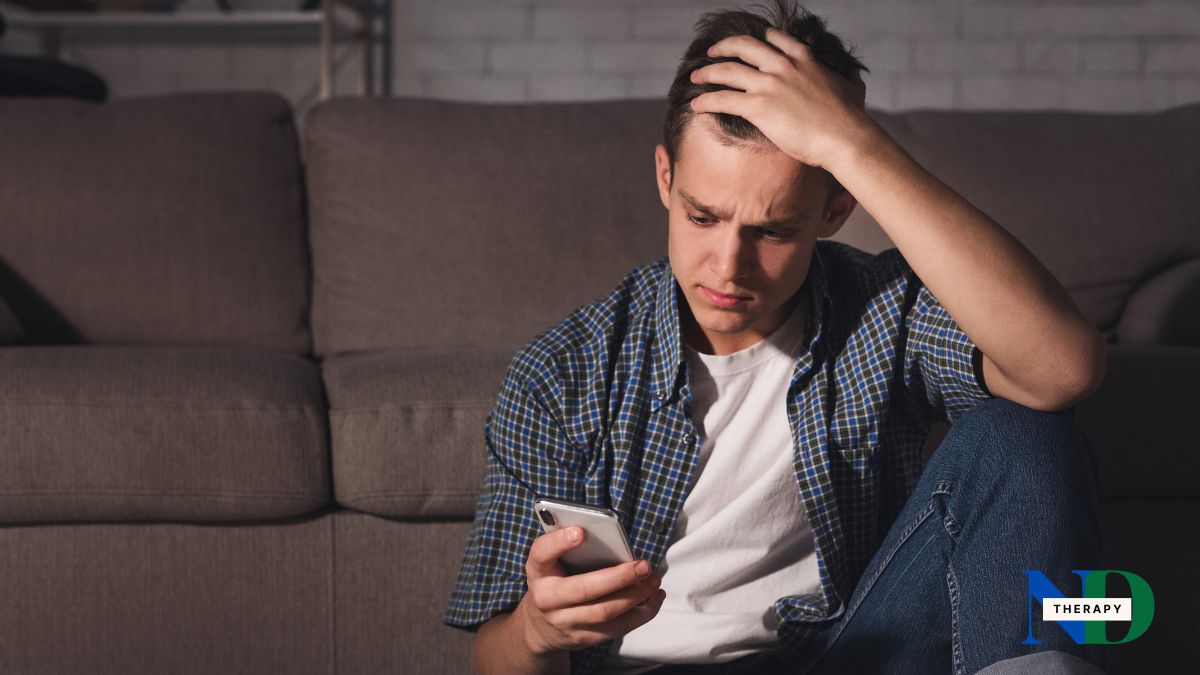
The tablet meltdown isn't defiance — it's a brain doing exactly what its wiring asks, and understanding why is the first step to actually helping.

You already know the scene. The tablet has been on for two hours, dinner is ready, and the moment you ask for it back, the whole house tips over. Not a normal protest — a full collapse, as if you have taken away something your child needs to breathe. You are left standing there, wondering whether you are watching a kid who simply loves their game or something that has quietly become more than a hobby.
If your child is autistic, that question deserves a real answer, because the honest one is this: autistic kids are more vulnerable to screen and internet addiction than their peers, and it is not because of anything you did wrong. The pull of the screen lines up almost perfectly with how the autistic brain is wired. I have spent sixteen years working with both high-functioning autism and internet addiction, and I lived through my own addiction to the screen before that. What follows is what I have learned about why the risk is higher and what actually helps.
Is Screen Addiction Really More Common in Autistic Children?
Yes. This is one of the more consistent findings in the research, not a hunch. Systematic reviews of the literature have confirmed that autistic children, teens, and adults are at greater risk of problematic gaming and internet use than their non-autistic peers. In one clinical study, roughly 45 percent of autistic youth scored above the cutoff for Internet Gaming Disorder, compared with about 9 percent of a typical comparison group. Autistic children also tend to spend more of their free time gaming than their non-autistic siblings.
I want to be clear about what this means and what it does not. It does not mean every autistic child who loves Minecraft is an addict. It does mean that if you have felt a particular kind of worry about your child and screens — a worry that seems sharper than what other parents describe — your instinct is grounded in something real. The vulnerability is structural. It comes from the wiring, not from weak parenting or a weak child.
Why Are Autistic Brains More Drawn to Screens?
To understand the risk, you have to understand the appeal. A screen is not just entertainment to an autistic child. It is often the one place in the day that gives them exactly what the rest of the world withholds.
Predictability and control. The offline world is loud, fast, and full of social rules that change without warning. A game is the opposite. It runs on rules that never shift, it responds the same way every time, and it can be paused. For a brain that finds unpredictability genuinely distressing, that reliability is not a luxury — it is relief.
Reward sensitivity. Games are engineered to deliver frequent, immediate rewards: points, levels, loot, the next small win always seconds away. Many autistic children also have ADHD — a meta-analysis of 63 studies put the figure at roughly 40 percent — and an ADHD brain craves exactly that kind of instant, novel stimulation. Daily life off the screen rarely competes with a reward schedule built in a lab.
Special interests. The deep, focused interests that are a hallmark of autism are a strength. But when that capacity for total absorption points at an open-ended digital world, it can pour in with an intensity that has no natural stopping point. The same trait that lets your child master a subject completely can keep them locked to a screen for hours.
Sensory and emotional regulation. For many autistic kids, a screen is a way to turn the volume of the world down. After a day of bright lights, unspoken social demands, and the constant effort of holding it together, the game is where the nervous system finally settles. That is why removing it can trigger a reaction that looks wildly out of proportion — you are not taking away a toy; you are taking away the thing that regulates them.
Why Is It Harder for Autistic Kids to Stop?
The pull explains why screens draw autistic children in. A second set of differences explains why getting out is so much harder for them than for a typical child.
Executive function. The brain systems that handle planning, impulse control, and task switching tend to develop differently in autism. Stopping a rewarding activity in the middle requires exactly those systems. Asking an autistic child to simply self-regulate off a screen is often asking them to use the muscle that is hardest for them.
Transitions and time blindness. Moving from one activity to another is one of the most consistently difficult things for autistic children, and screens make transitions even harder by erasing the sense of time passing. “Five more minutes” genuinely does not register the way it does for other kids. The clock outside the game stops existing.
Masking fatigue. Many high-functioning autistic children spend the entire school day masking — consciously suppressing their natural responses to appear neurotypical. It is exhausting in a way that is hard to overstate. By the time they get home, the screen is not a want; it feels like the only available place to decompress. That makes it far more entrenched than ordinary screen habits, and far more painful to interrupt.
When Online Worlds Replace Real Connection
There is a deeper reason screens take hold, and it is the one parents tend to feel most. Online spaces strip out the hardest parts of human connection. There is no eye contact to manage, no body language to decode in real time, no awkward pause that has to be filled. A child who struggles socially in person can feel competent, even popular, inside a game or a server.
That is a real gift, and it is also the danger. The online world becomes appealing precisely because it removes the friction that in-person relationships require — and because it removes that friction, your child never gets to practice tolerating it. Over time, the easier digital version can quietly crowd out the harder, more nourishing real-world version. For autistic adults, this same pattern can harden into near-total withdrawal. If you recognize yourself, and not just your child, in this description, my high-functioning autism reflection tool is a private, free way to start putting words to it.
How Can Parents Tell a Special Interest From an Addiction?
This is the question I am asked most, and it matters because a passionate special interest and an addiction can look identical from the outside. Both involve a child who is deeply, intensely focused on a screen. The difference is not the number of hours. It is what the screen is doing in their life.
A healthy special interest tends to add to a child’s life: they light up talking about it, they build real skills, they can step away — reluctantly, but they can — and the rest of life still functions. An addiction tends to subtract. Sleep, school, hygiene, family relationships, and every other interest start shrinking to make room for the screen, and attempts to cut back are met not with disappointment but with genuine distress. The clearest single test I give parents is this: when the screen goes away for a while, does the rest of your child’s life expand back to fill the space, or does everything just stop until the screen comes back?
If you are not sure where your child falls, you do not have to guess. My free internet addiction self-assessment walks you through the specific signs clinicians look for, with a private parent version written for exactly this situation. It will not diagnose your child, but it will tell you whether what you are seeing is worth a closer look.
What Can Parents Actually Do?
Here is the part most advice gets wrong. The instinct is to fight the screen — to cut the cord, set hard limits, and brace for the war. With an autistic child, that approach usually backfires, because you are removing the one thing regulating them without replacing it. What works is gentler, slower, and more strategic.
Build structure instead of imposing restrictions. Autistic children do not respond well to arbitrary, shifting limits, but they thrive on predictable structure. A clear, visual, consistent routine — screen time at the same points each day, with the same warnings before it ends — works far better than a parent making a new judgment call every afternoon. The rule should feel like the weather, not like a fight.
Replace, do not just remove. Always ask what need the screen is meeting before you take it away. If it is a regulation, your child needs another way to regulate. If it is a connection, they need another place to feel competent. Removing the screen without offering a substitute for what it was doing leaves a vacuum that the screen will rush back to fill.
Make transitions concrete. Because time blindness is real, abstract warnings fail. Visual timers, a defined end-of-session ritual, and a known next activity give the brain something to hold on to. You are not just ending the game; you are handing your child a bridge to what comes next.
Co-regulate before you expect self-regulation. A child cannot practice a skill they do not have yet. Your calm, steady presence during the difficult transition teaches the nervous system that coming off the screen is survivable. That is built slowly, with you alongside them, not by leaving them to white-knuckle it alone.
And if the patterns in this article describe your home closely — if screens have started subtracting from your child’s life rather than adding to it — that is worth a real conversation. I work with families across Texas on exactly this intersection of autism and screen use. You can read more about how I treat internet addiction and reach out if it feels like the right time.
Takeaway
Autistic children are more vulnerable to screen addiction because the screen offers them what the world often does not: predictability, control, reliable reward, a place to regulate, and connection without the friction of in-person interaction. That same wiring makes stopping genuinely harder. None of it is a parenting failure. The most useful thing you can do is stop treating the screen as the enemy and start asking what it is doing for your child — then build structure, offer real replacements, and walk them through the hard transitions instead of leaving them to manage alone. If you are trying to figure out whether what you are seeing crosses the line from passion into addiction, the free assessments on this site are a calm, private place to start.
References
- Craig, F., et al. (2021). • Craig, F., Tenuta, F., De Giacomo, A., Trabacca, A., & Costabile, A. (2021). A systematic review of problematic video-game use in people with Autism Spectrum Disorders. Research in Autism Spectrum Disorders, 82, 101726. doi:10.1016/j.rasd.2021.101726
- Autism, Problematic Internet Use and Gaming Disorder: A Systematic Review (2021). Review Journal of Autism and Developmental Disorders. link.springer.com/article/10.1007/s40489-021-00243-0
- Internet Gaming Disorder in Children and Adolescents with ASD and ADHD (2024). Brain Sciences — found ~45% of ASD youth above the IGD cutoff vs ~9.5% of controls. ncbi.nlm.nih.gov/pmc/articles/PMC10887068/
- Liu, S., et al. (2017). Longitudinal study: autistic traits relate to reduced emotion regulation and school connectedness, which predict increased internet gaming addiction. pubmed.ncbi.nlm.nih.gov/28755535/
- • Rong, Y., Yang, C.-J., Jin, Y., & Wang, Y. (2021). Prevalence of attention-deficit/hyperactivity disorder in individuals with autism spectrum disorder: A meta-analysis. Research in Autism Spectrum Disorders, 83, 101759 — pooled ADHD prevalence in ASD ~40%. doi:10.1016/j.rasd.2021.101759

- Why Kids Can’t Stop Playing Roblox — and What Parents Can Do About It - September 16, 2026
- What the Texas App Store Law Changes for Parents - September 2, 2026
- Thirty Days Will Not Cure You - August 26, 2026
Could I, or My Child, Be Autistic?
Take my free Autism Traits Reflection Tool to see if a formal Autism diagnosis is recommended. About twenty questions, fifteen minutes, with your results on screen right away. There are two versions — choose the one that fits: an adult reflecting on themselves, or a parent or caregiver reflecting on a teen or young adult.
No spam. Your email is only used to send your results guide and the short follow-up sequence, and you can unsubscribe anytime. This is a reflection tool, not a diagnosis.