Your hand moves before you decide to. Here is what happens in that gap — and why willpower keeps losing the argument.

What Actually Happens in the Moment Before You Pick Up the Phone
"I was standing in my kitchen waiting for coffee to brew. Ninety seconds. Nothing to do, nothing wrong, nothing urgent. And somewhere between one thought and the next, my phone was in my hand, and I was three swipes into a feed I did not care about."
I want to be precise about this, because the precision matters: I did not decide to pick up the phone. There was no moment where I weighed it, considered the alternatives, and chose badly. The reach had already happened by the time I noticed it.
Researchers have a name for this. They call it a checking habit — a brief, repetitive inspection of whatever is new on the device, performed so often and so automatically that it stops registering as a choice at all. In one of the foundational studies on the pattern, participants described their own checking not as craving or pleasure, but mostly as an annoyance (Oulasvirta et al., 2012). They were not enjoying it. They were not fighting it either. They were simply doing it, dozens of times a day, the way you blink.
That detail should change how you think about your own screen use. If this were pleasure-seeking, you would at least be getting pleasure. Most of the time you are not. The reach is not a decision you lost. It is a decision you never made.
Boredom Isn't the Enemy — It's the Signal
Here is the piece almost everyone gets backward. The problem is not that you are weak in the phone's presence. The problem is what happens in the seconds just before it — the small, unstructured, unassigned gap. The boredom.
We are not neutral about that gap. In a well-known set of eleven studies, researchers left participants alone in a room for six to fifteen minutes with nothing to do but think. Participants consistently disliked it. In one variation, a substantial number chose to give themselves a mild electric shock rather than sit with their own thoughts and nothing else — a shock they had earlier said they would pay money to avoid (Wilson et al., 2014).
That finding is often quoted, usually to prove that human beings cannot stand to think. It does not quite prove that, and researchers have debated how far it extends. But it demonstrates something narrower and, for our purposes, more useful: an unoccupied mind reaches for something. Anything. Even something it does not like.
So boredom is not the enemy here. Boredom is information. It is your nervous system reporting an open loop with nothing assigned to it. And in 2026, the fastest thing standing next to that open loop is a rectangle in your pocket.
This is the same mechanism I described in "Living for the Weekend," just at a smaller scale. There, the structure that collapsed was a week. Here, it is 90 seconds to wait for coffee. Same shape. Same gap. Same thing rushing in to fill it.
Why the Phone, Specifically?
There are a hundred things you could do with an empty ninety seconds. Look out the window. Stretch. Think about the day. Do nothing at all. So why, every single time, the phone?
Because the phone holds three properties at once, and nothing else in the room holds all three.
1. The friction is nearly zero
The distance between wanting something and getting something has collapsed to about one second and one gesture. Nothing else you might reach for competes with that. A book has to be found and opened. A conversation requires another person. The phone requires only that your hand already knows the way.
2. The payoff is unpredictable — and that is the entire trick
This is the part that took me years to actually understand. Dopamine is not the "pleasure chemical," whatever you have read. The underlying neuroscience shows that dopamine neurons fire in response to prediction error — the difference between what you expected and what you got. A reward you can perfectly predict produces little to no signal (Schultz et al., 1997).
Read that again, and then think about what a feed is.
A feed is a machine for never letting you predict. You do not know if this refresh has something good in it. You do not know if the notification is the one that matters. That uncertainty is not a side effect of the design — it is the product. It is why the content can be genuinely mediocre, and you can know it is mediocre, yet still be pulling the handle. You are not there for the content. You are there for the not-knowing.
And note how neatly this aligns with the checking-habit research: the behavior is reinforced specifically by fast rewards (Oulasvirta et al., 2012). Speed plus uncertainty is the whole recipe.
3. The supply is infinite
A book has a last page. A conversation ends. A walk gets you home. The feed has no bottom, and therefore no natural moment where stopping is the obvious next thing to do. You have to manufacture the stopping point yourself every time, from scratch, against a system engineered to ensure you never encounter one.
Frictionless, unpredictable, infinite. Put those three together and the honest question stops being "why do I keep reaching for it" and becomes "what on earth would I be reaching for instead?"
The Loop Closes Faster Every Time
Every time the reach happens and delivers anything at all — a message, a laugh, thirty seconds of distraction — the link between the gap and the phone gets a little stronger. Boredom, phone, relief. Boredom, phone, relief. It is not dramatic. It is just repetition, and repetition is enough.
Two things happen as that loop tightens, and both of them are worth watching for in yourself.
- The reach gets faster. It moves from a choice, to a habit, to something that has already happened by the time you catch it. This is the preconscious stage, where most adults I work with actually live.
- The threshold drops. You used to need ten minutes of nothing before you reached. Then two. Then the elevator. Then the red light. Then the three seconds while a page loads.
That second one is what finally got my attention, back when I was in it. Not the hour count. Not the screen-time report. It was noticing that I could not hold three seconds of nothing without reaching — and that I had not chosen that, and could not remember agreeing to it.
Why Willpower Is the Wrong Tool for This
Now put those two facts side by side.
Willpower operates on decisions. It is the thing you use at the fork in the road. But by the time you are aware of the phone in your hand, the behavior has already run. There was no fork. You cannot out-decide something that happened before deciding.
So here is what actually happens to people. They resolve to do better. They white-knuckle it for a few days. Then they catch themselves mid-scroll, again, and they draw the only conclusion the framing allows: that they are weak, undisciplined, a little pathetic. And that verdict is so unpleasant that the fastest available relief from it is — of course — the phone.
You are not weak. You are using a tool built for one job on a completely different job. Willpower shows up at the fork, and the fork is not where this is being decided.
Which means the leverage has to sit somewhere else: earlier in the chain, at the cue and the friction and what is standing next to you when the gap opens. That is not a matter of resolve. That is a matter of engineering — and it is what Thursday's piece is about.
What This Means for You
If you take nothing else from this, take these five things.
- The reach is not a moral failure. It is a trained response, and it was trained deliberately.
- Boredom is the trigger, not the enemy. The gap is normal. What fills it is the question.
- The phone wins because it is frictionless, unpredictable, and infinite. Not because you are weak.
- Uncertainty is the hook, not content. This is why the feed can be boring and still hold you.
- Willpower arrives too late. Change the cue and the friction, not the resolve.
And notice, this week, what is actually happening in the two seconds before your hand moves. Do not fix it yet. Just watch it. Most people have never once looked directly at that moment, and it is remarkable how much it tells you.
Where to Start
If you are reading this and quietly recognizing more of yourself than you expected, it is worth finding out where you actually stand. My free Internet Addiction Assessment takes a few minutes, runs entirely in your browser, and gives you an honest picture of the pattern rather than a label.
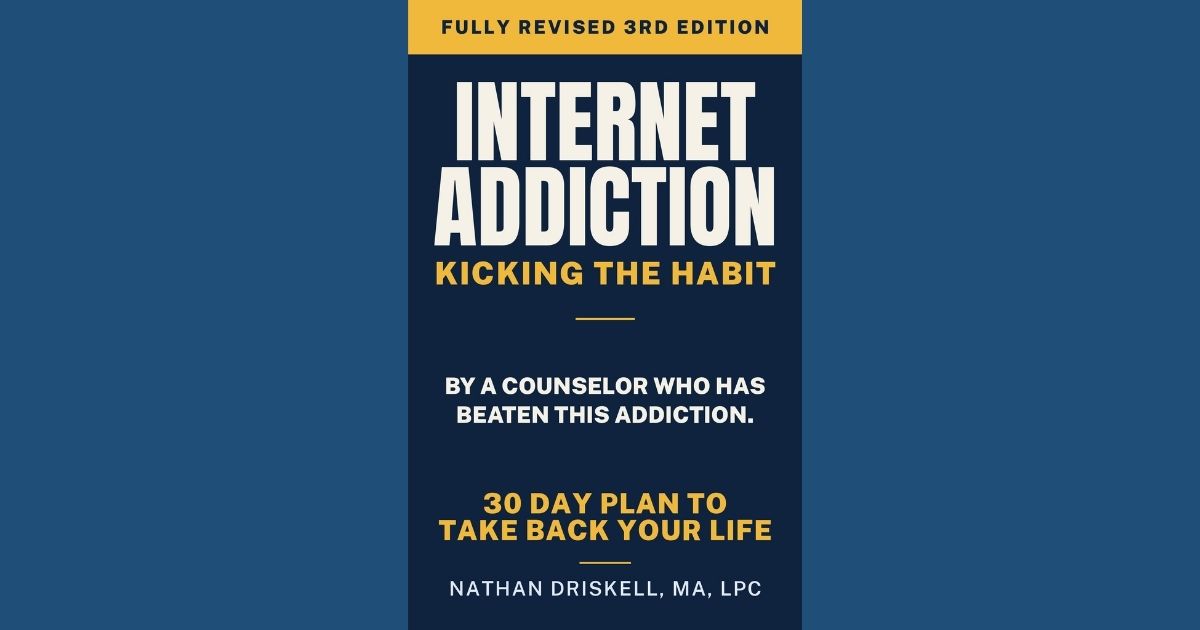
And if you want the full structure — the thirty-day version of this work, the one I built out of my own recovery and sixteen years of sitting with people in it — that is Internet Addiction: Kicking the Habit.
References
Oulasvirta, A., Rattenbury, T., Ma, L., & Raita, E. (2012). Habits make smartphone use more pervasive. Personal and Ubiquitous Computing, 16(1), 105–114. https://doi.org/10.1007/s00779-011-0412-2
Schultz, W., Dayan, P., & Montague, P. R. (1997). A neural substrate of prediction and reward. Science, 275(5306), 1593–1599. https://doi.org/10.1126/science.275.5306.1593
Wilson, T. D., Reinhard, D. A., Westgate, E. C., Gilbert, D. T., Ellerbeck, N., Hahn, C., Brown, C. L., & Shaked, A. (2014). Just think: The challenges of the disengaged mind. Science, 345(6192), 75–77. https://doi.org/10.1126/science.1250830

- Why Kids Can’t Stop Playing Roblox — and What Parents Can Do About It - September 16, 2026
- What the Texas App Store Law Changes for Parents - September 2, 2026
- Thirty Days Will Not Cure You - August 26, 2026
Recognize Yourself — or Your Child — In This Article?
Take my free Internet Addiction Self-Assessment to see where the patterns fall on the clinical spectrum. Twenty questions, fifteen minutes, with your results on screen right away. There are two versions — choose the one that fits: an adult assessing themselves, or a parent or caregiver assessing a teen or young adult.
No spam. Your email is only used for the follow-up sequence and my newsletter — your answers on the assessment never leave your browser. Unsubscribe anytime. This is a screening tool, not a diagnosis.