The problem usually isn't discipline itself. It's the area of your life you've been avoiding. An honest look at pleasure, purpose, and the reps that change things.

I want to start by telling you something true about me: I sometimes live for the weekend, too.
There are weeks when I feel it — the low hum that starts on Monday, the quiet countdown that kicks in around Wednesday, the sense that real life is the two days at the end and everything before it is just something to get through. I have fought this pattern. I still fight it. I am a therapist who specializes in addiction, and I have my own history with it, so I can tell you plainly that the pull toward “just get me to Friday” never fully disappears. It quiets. It becomes manageable. But it does not vanish, and anyone who tells you they have it perfectly solved is probably selling you something.
So this is not a piece where I stand above you and point. It is one where I stand next to you and say: here is a problem most of us share on some level, here is where I think it actually comes from, and here is what we can do about it — starting small.
The problem is discipline, or rather its slow erosion. And I want to be honest about that word, because many people flinch at it. Discipline sounds like punishment, rigidity, a joyless life of cold showers and denial. That is not what I mean. I mean the willingness to show up for the parts of your life that matter even when they are not fun in the moment. When we lose that willingness, one of two things tends to happen: things fall apart, or they shrink to the bare minimum. That is a real problem — not merely a symptom to wave away. But its root is almost never a character flaw. That distinction is the whole point of this article.
Living for the Weekend Is Usually Running From Something
“Living for the weekend” sounds harmless — even relatable, even funny on a mug. But underneath the joke there is usually something heavier: avoidance. If Monday through Friday is something to be endured, it is often because some area of life feels beyond our control, or too hard or too painful to change.
Maybe it is a job that quietly drains you. Maybe it is a relationship that has gone silent. Maybe it is a body you have been at war with for years, or a dream you set down so long ago you have stopped mentioning it out loud. The weekend becomes the escape hatch — the place you go to not feel the thing you spend the week not looking at.
I want to name that clearly, because it changes everything about how we respond: this is not laziness. It is avoidance. And people do not avoid things because they are weak. They avoid things because those things hurt, and because facing them feels bigger than they are. That is human. It is also where the trouble begins.
When Work Stopped Being a Source of Meaning
For a long stretch of human history, work was one of the main sources of meaning people found. Doing a job well gave a sense of completion — the quiet satisfaction of being good at something that mattered to someone. The craftsman, the farmer, the teacher, the builder: the work itself carried a kind of dignity, and that dignity fed the person doing it.
Viktor Frankl, the psychiatrist and Holocaust survivor, argued in Man’s Search for Meaning that the search for meaning is not a luxury but a central human drive — that we can endure almost any “how” if we have a “why.” When work supplies part of that “why,” the week has a spine to it. When work becomes only about money — a transaction, a way to survive until Friday — a vacuum opens where the meaning used to be.
And that vacuum is not harmless. Purpose turns out to be genuinely protective. In a study following adults over 14 years, researchers found that people who reported a stronger sense of purpose in life actually lived longer than those who did not, even after accounting for other measures of well-being (Hill & Turiano, 2014). Purpose is not a soft, optional extra. Its presence protects us, and its absence costs us.
I am not saying everyone must find their meaning at work — many people find it in family, faith, service, craft, or community, and that is entirely valid. The point is simpler and harder: meaning has to come from somewhere. When it drains from the largest block of our waking hours, and nothing replaces it, we start looking for something to fill the space.
What We Reach For to Fill the Gap
Into that empty space, we reach for something. Food. Screens. Alcohol. Drugs. Pornography. Sex. Gambling. The endless, thumb-worn scroll. The specific object varies from person to person, but the motion is the same — a reach for something that will change how we feel, quickly.
Here is where the clinical picture is more compassionate than the culture usually allows. We tend to assume people chase these things for pleasure — that it is simple appetite, or greed, or weakness. But decades of clinical observation point somewhere else. In his work on what is called the self-medication hypothesis, the addiction psychiatrist Edward Khantzian argued that people are drawn to these behaviors less to feel good and more to stop feeling bad — to relieve, dull, or distract from painful emotional states they do not know how else to manage (Khantzian, 1997).
Khantzian’s most useful question, the one I carry into my own practice, is not “What is wrong with you?” but “What did this do for you?” It reframes the whole thing. The drink, the binge, the six hours of gaming, the compulsive scroll — each one was, at first, a partly successful attempt to cope with something real. That is not weakness. It is an attempt at self-repair.
But — and this is the honest part I will not soften — the coping becomes its own problem. The thing that helped us survive the week starts to run the week.
The Loop: How Chasing Pleasure Quietly Erodes Discipline
The psychiatrist Anna Lembke describes, in her book Dopamine Nation, how the brain balances pleasure and pain like a seesaw. When we repeatedly lean on a quick hit of pleasure, the seesaw tips back toward pain to compensate. Over time, we need more of the thing just to feel normal, and we feel worse in the spaces between. The relief gets shorter; the emptiness afterward gets longer.
This is where a loop forms, and I want to trace it plainly because naming it is how you start to step out of it:
- You avoid an area of life that feels out of your control.
- You reach for something to relieve the discomfort of avoiding it.
- That relief costs you discipline — energy, hours, attention, follow-through.
- With less discipline, the avoided area slides a little further.
- Now there is even more to avoid — so you reach again.
Around and around. And here is the point where I want to be direct rather than merely gentle: the discipline problem is real. Once this loop is running, low discipline stops being just a symptom and becomes its own engine. You start doing the bare minimum. You let the small things slide — the dishes, the email, the workout, the hard conversation — and every slide quietly confirms the story that you are someone who cannot change.
I have lived inside this loop. I know how convincing that story becomes from the inside. It is not a moral failure — I do not believe that, and I would not say it to a client or to you. But it is real, and it compounds. Pretending otherwise does not help anyone. The way out is not to hate yourself into discipline. It is to interrupt the loop at the one place you actually have leverage.
The Hard Truth: Name the Area You’re Avoiding
So here is the hard truth, and I offer it as someone who has had to sit with it myself: you almost certainly already know which area of your life is out of balance.
It is the one your mind skips past. The thought that surfaces at 2 a.m. and gets pushed back down. The subject you change when a friend gets too close to it. You do not need a questionnaire to find it. You need one honest sentence, said plainly to yourself, without the usual softening.
“My health is out of balance, and I have stopped trying.” “I don’t hate my job — I’ve given up on it, which is worse.” “My drinking is not casual anymore.” “I reach for my phone every time I feel anything at all.” Whatever the true sentence is for you, saying it is the beginning. Not the whole journey — the beginning. But nothing moves until it is named.
And I want to guard something here, because it matters clinically: naming the area is not the same as beating yourself up over it. Shame is not the cure — it is part of the loop. Khantzian spent his career arguing that what helps people is understanding and feeling understood, not being shamed (Khantzian, 1997). The first person who has to understand you, with honesty and without contempt, is you. Name the thing the way you would name it for someone you love: clearly, and kindly.
Change One Area, One Small Step at a Time
Once you have named it, the temptation is to fix it all at once — the dramatic overhaul, the Monday-morning new-you, the clean slate. I understand the appeal. I also want to gently talk you out of it, because those overhauls usually collapse within two weeks, and every collapse hands more evidence to the story that you cannot change.
Lasting change does not come from intensity. It comes from repetition in one small place. Researchers who tracked people forming new habits in daily life found it took, on average, about 66 days for a new behavior to become automatic — with a range from around 18 days to well over 200, depending on the person and the behavior (Lally et al., 2010). Read that again, because it is oddly freeing: it is supposed to feel slow and awkward for a while. The awkwardness is not failure. It is the timeline.
So pick the smallest honest step in the one area you named — small enough that it feels almost too easy, small enough that you cannot talk yourself out of it on a bad day.
- Not “get fit.” Put your shoes on and walk to the end of the street. That is the whole task.
- Not “fix my career.” One hour a week on the thing you set down years ago.
- Not “quit the scrolling.” Charge the phone in another room for the first ten minutes of the day.
Discipline is not a trait you were born with or without. It is rebuilt in reps, and reps compound. Each small kept promise to yourself is a quiet vote for a different story — the story that you are, in fact, someone who follows through. Do that in one area, consistently, and something surprising happens: the discipline starts to spill into the others. You did not need more willpower. You needed one true step, taken often enough that it stopped being a decision and started being who you are.
If you do only one thing after reading this: name your area, choose the smallest step, and do it tomorrow. Then do it the day after. That is not a small thing dressed up as a big one. That is how it actually changes.
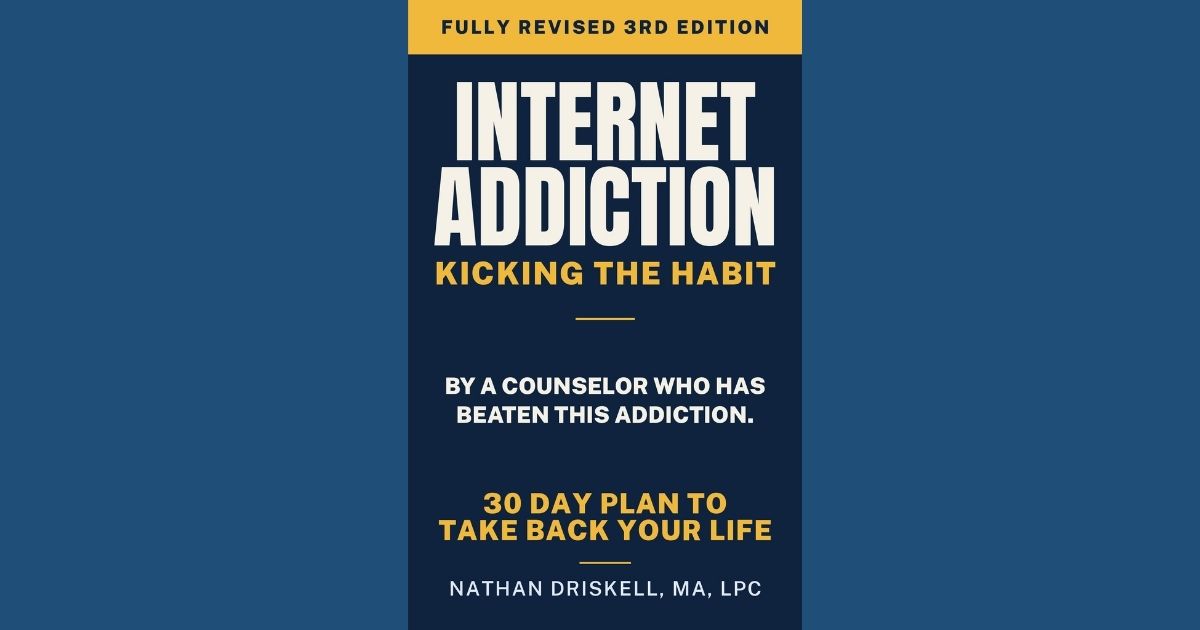
If the area you named is a screen, a substance, or a compulsion that has crossed from a habit you have into something that has you — that is the work I do every day, and it is more common than the quiet around it suggests. You are not weak, and you are not alone in it. If you want an honest, private place to start, my free Internet Addiction Assessment can help you see where you actually stand, and my book Internet Addiction: Kicking the Habit walks through the path out in more depth. I am still doing my own reps, too. We take the first step together.
References
Hill, P. L., & Turiano, N. A. (2014). Purpose in life as a predictor of mortality across adulthood. Psychological Science, 25(7), 1482–1486. https://doi.org/10.1177/0956797614531799
Khantzian, E. J. (1997). The self-medication hypothesis of substance use disorders: A reconsideration and recent applications. Harvard Review of Psychiatry, 4(5), 231–244. https://doi.org/10.3109/10673229709030550
Lally, P., van Jaarsveld, C. H. M., Potts, H. W. W., & Wardle, J. (2010). How are habits formed: Modelling habit formation in the real world. European Journal of Social Psychology, 40(6), 998–1009. https://doi.org/10.1002/ejsp.674
Frankl, V. E. (1959/2006). Man’s search for meaning. Beacon Press.
Lembke, A. (2021). Dopamine nation: Finding balance in the age of indulgence. Dutton.

- Why Kids Can’t Stop Playing Roblox — and What Parents Can Do About It - September 16, 2026
- What the Texas App Store Law Changes for Parents - September 2, 2026
- Thirty Days Will Not Cure You - August 26, 2026
Recognize Yourself — or Your Child — In This Article?
Take my free Internet Addiction Self-Assessment to see where the patterns fall on the clinical spectrum. Twenty questions, fifteen minutes, with your results on screen right away. There are two versions — choose the one that fits: an adult assessing themselves, or a parent or caregiver assessing a teen or young adult.
No spam. Your email is only used for the follow-up sequence and my newsletter — your answers on the assessment never leave your browser. Unsubscribe anytime. This is a screening tool, not a diagnosis.