The urge will pass whether you feed it or not. That single fact is the whole intervention.

The Urge Is a Wave, Not a Verdict
On Tuesday I wrote about the reach — the way your hand finds the phone before you have decided anything at all. Today I want to talk about what to actually do in that moment, and I want to start by taking one thing off the table.
You are not going to defeat the urge. That is not the goal, and every plan built to defeat it will fail.
There is a technique from relapse prevention called urge surfing — the practice of watching an urge rise, crest, and fall without acting on it, much like watching a wave from the shore rather than fighting it. When researchers tested a brief version of this with smokers, the result was not what most people expect. The participants' urges did not get smaller. What changed was what they did about them. They smoked less anyway (Bowen & Marlatt, 2009).
I want you to sit with that for a second, because it reframes the entire task.
The intervention does not make the wanting go away. It breaks the link between the wanting and the reaching. You can want the phone, fully and uncomfortably, and not pick it up — and doing that does not require you to be a stronger person. It requires you to stop treating the urge as a verdict on your character and start treating it as weather.
The urge is going to arrive. It is going to peak. It is going to leave. It will do all of that whether you feed it or not. The only question is what you are doing while it passes.
Why "Just Don't" Fails
Tuesday's piece laid out the mechanism, so I will keep this to three sentences. The reach happens before conscious decision. Willpower operates at the decision. So telling yourself to just not do it is arriving at the scene of a crime that already happened.
Which means everything below operates somewhere other than resolve. Not one of these three moves asks you to want it less. They all assume you will want it exactly as much as you do right now.
Move One: Put Something in the Way
The single highest-leverage change is also the least glamorous: increase the number of seconds between the impulse and the payoff.
Not because friction is a test of virtue. Because friction is the only intervention that operates before the reach — it works on the environment, not on you. A phone in a drawer in another room does not require you to be disciplined. It requires you to walk.
Practical versions, in rough order of how much they actually buy you:
- Phone charges outside the bedroom, overnight, always. This one is not negotiable, and it is where I would start.
- Grayscale. It sounds trivial. It removes a substantial amount of what makes the feed feel alive.
- The worst offender gets deleted from the phone and lives only in a browser, logged out. You can still get there. It just costs you ninety seconds and a password.
- Notifications off for anything that is not a human being contacting you directly.
You will notice none of this is abstinence. You are not building a wall. You are buying seconds — and seconds are enough, because the reach is fast but it is not durable. What it cannot survive is a delay long enough for you to notice it happening.
Move Two: Name the Job the Screen Was About to Do
This is where most people go wrong, and it is the same error parents make with children: they remove the screen without asking what it was for.
The phone is doing a job. It is always doing a job. And the job isn't the same every time.
- Boredom. An open loop with nothing assigned to it. Needs stimulation.
- Avoidance. There is a task, an email, a conversation you do not want to face. Needs the first small step of the thing you are avoiding, not a substitute.
- Loneliness. Wanting contact. Needs actual contact — and a feed is a very convincing counterfeit of it.
- Dread or anxiety. Needs regulation: movement, breath, air, a walk around the block.
A substitute that does not match the job will not hold. If you are lonely and you go for a run, the run does not touch it, and you will be back on the phone within the hour — and then you will decide the problem is that you have no willpower, when in fact the problem is that you answered the wrong question.
So the move is: before you reach, ask what you are reaching for. Not rhetorically. Actually name it. It takes four seconds, and it is the most useful four seconds in this entire article.
Move Three: Decide Before You Need To
The problem with all of the above is that it asks you to think clearly in exactly the moment you are least able to.
So do not decide in the moment. Decide now.
There is a large and unusually solid body of research on a technique called an implementation intention — a simple if-then plan, formed in advance, that links a specific situation to a specific response. "If I find myself reaching for my phone in the kitchen, then I will pour a glass of water and look out the window." A meta-analysis of hundreds of studies found that these plans reliably improve follow-through, and the reason they work is precisely the reason they matter here: they hand control of the behavior to the situational cue rather than to your deliberation (Gollwitzer, 1999; Gollwitzer & Sheeran, 2006).
Read that against Tuesday's article, and you will see why this is not just another tip.
The reach is automatic. Willpower is deliberate, and it shows up too late. An if-then plan is the one tool that is also automatic — it installs a response at the same layer where the problem lives. You are not out-arguing the habit. You are giving the cue to go somewhere else.
Write two or three of them. Be embarrassingly specific — the actual room, the actual trigger, the actual replacement. Vague plans do nothing.
When It Doesn't Work
It will not work sometimes. You will do all of this and still end up on the couch at 11:40 with a phone in your hand and no memory of picking it up.
What happens in the next ninety seconds is more important than the lapse itself.
Because there is a predictable second act here, and it is the one that does the real damage. You catch yourself. You feel the flush of failure. You think: I am pathetic, nothing works, why do I even try. And then — this is the part almost nobody sees coming — the fastest available relief from feeling like a failure is the exact device in your hand. So the lapse becomes an evening. Not because the urge was strong, but because the shame was.
Relapse prevention has a name for this pattern: the way a single slip gets interpreted as proof of total failure, which then licenses the full collapse (Marlatt & Gordon, 1985).
So the instruction is unglamorous, and it matters more than any of the three moves above: notice the reach, put the phone down, and do not hold a trial. No self-recrimination, no re-litigating your character, no promises. You reached. The plan did not cover that situation. Now you know one more situation. Write the if-then for it tomorrow.
I lapsed for years while getting better the whole time. Both of those things are true, and they were true simultaneously. Recovery is not the absence of the reach. It is the shrinking of what the reach costs you.
What to Actually Do This Week
- Stop trying to win. The urge does not shrink. Your response to it changes.
- Buy seconds. Phone out of the bedroom tonight. That is the whole assignment for day one.
- Name the job. Bored, avoiding, lonely, or anxious. Four seconds. Different answer each time.
- Write two if-thens. Specific room, specific trigger, specific replacement.
- Do not hold a trial. The shame spiral costs more than the lapse.
Where to Start
If you want to know where you actually stand before you start changing anything, my free Internet Addiction Assessment takes a few minutes and runs entirely in your browser. Nothing is transmitted, nothing is stored, and you get an honest picture of the pattern rather than a label.
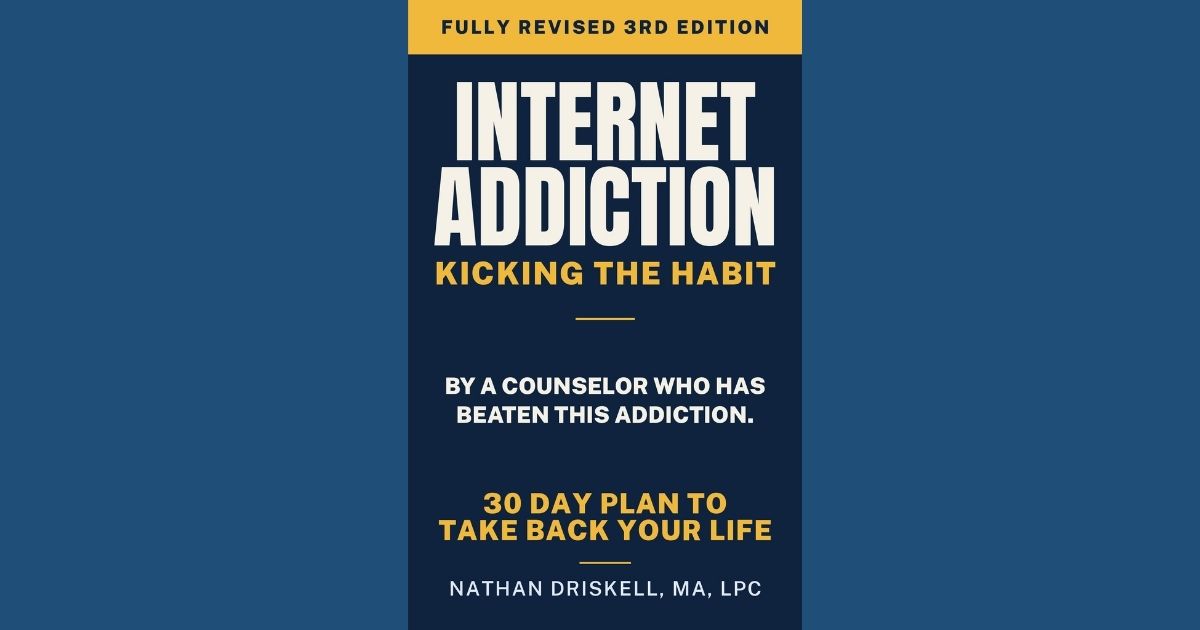
And if you want the structured version of everything above — thirty days of it, built out of my own recovery and sixteen years of sitting with people in theirs — that is Internet Addiction: Kicking the Habit.
References
Bowen, S., & Marlatt, A. (2009). Surfing the urge: Brief mindfulness-based intervention for college student smokers. Psychology of Addictive Behaviors, 23(4), 666–671. https://doi.org/10.1037/a0017127
Gollwitzer, P. M. (1999). Implementation intentions: Strong effects of simple plans. American Psychologist, 54(7), 493–503. https://doi.org/10.1037/0003-066X.54.7.493
Gollwitzer, P. M., & Sheeran, P. (2006). Implementation intentions and goal achievement: A meta-analysis of effects and processes. Advances in Experimental Social Psychology, 38, 69–119. https://doi.org/10.1016/S0065-2601(06)38002-1
Marlatt, G. A., & Gordon, J. R. (Eds.). (1985). Relapse prevention: Maintenance strategies in the treatment of addictive behaviors. Guilford Press.

- Why Kids Can’t Stop Playing Roblox — and What Parents Can Do About It - September 16, 2026
- What the Texas App Store Law Changes for Parents - September 2, 2026
- Thirty Days Will Not Cure You - August 26, 2026
Recognize Yourself — or Your Child — In This Article?
Take my free Internet Addiction Self-Assessment to see where the patterns fall on the clinical spectrum. Twenty questions, fifteen minutes, with your results on screen right away. There are two versions — choose the one that fits: an adult assessing themselves, or a parent or caregiver assessing a teen or young adult.
No spam. Your email is only used for the follow-up sequence and my newsletter — your answers on the assessment never leave your browser. Unsubscribe anytime. This is a screening tool, not a diagnosis.