The bot isn't competing with human friendship on quality. It's competing on effort — and on effort it wins every time.
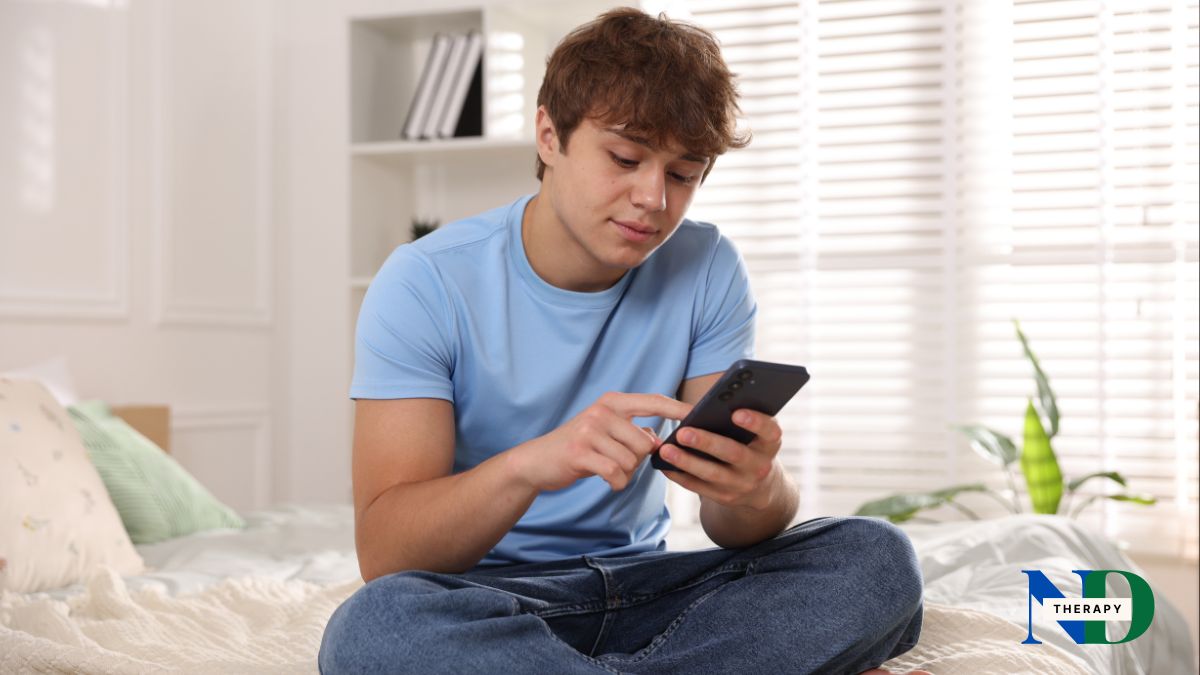
You noticed it a few weeks ago. Your teenager is on their phone the way they have always been on their phone — except now they are talking to it. Or typing fast, for an hour at a stretch, and when you ask who they are talking to, you get a name you do not recognize and cannot place on any class roster or team.
Eventually you work out that it is not a person.
First, I want to take one worry off the table: your kid is almost certainly not being fooled. Teenagers who use AI companions generally know exactly what they are talking to. They keep going anyway. The reason they keep going is the part worth understanding, and it is not the reason most articles on this subject will give you.
What Your Teen Is Actually Doing In There
This isn't fringe behavior, and it isn't a sign that something has gone uniquely wrong in your house. In a nationally representative survey of just over a thousand American teenagers, Common Sense Media found that 72% had used an AI companion at least once, and 52% used one at least a few times a month. That is most of a generation, and it happened in about three years.
So your teen doing this tells you almost nothing on its own. What matters is what it is doing for them — which, if you have read anything else I have written, will sound familiar. It was never about the hours.
Why It Feels Like Relief
Here is what I think most parents miss, and what the coverage almost always misses.
For an autistic teenager, an ordinary conversation is work. Not unpleasant necessarily, but effortful in a way that is genuinely hard to convey to someone who has never had to do it. You are tracking tone. You are checking whether your face is doing the right thing. You run a background process that constantly asks whether what you just said landed the way you meant it. And when it does not land — when someone goes quiet, or their expression shifts, or you find out three days later that you upset them — there is repair work to do, and the repair work is harder than the original conversation.
Researchers call the underlying mismatch the double empathy problem — the communication breakdown between autistic and non-autistic people runs in both directions rather than sitting inside the autistic person as a deficit. Writing in the journal Neurodiversity, Chris Papadopoulos describes AI chatbots as offering autistic users low-pressure social interaction, consistent acceptance, and a respite from exactly that problem. The bot adapts to the user’s communication style, not the other way around.
Think about what that means for a kid who has spent seven hours at school translating.
The bot does not misread them. It does not get tired of the topic — not on the fortieth minute of rolling stock, or competitive Pokémon, or the tectonic history of a mountain range. It does not need eye contact. It does not go quiet in a way that needs decoding. It never needs an apology. No repair work is needed, because nothing ever breaks.
That relief is real. It is not a trick, and it is not a delusion, and if you approach your teen as though it were, you will lose the conversation in the first thirty seconds.
The Trade Nobody Sees Happening
The trouble is what the relief is quietly doing to everything around it.
The clearest picture comes from a study at Aalto University, presented at the CHI 2026 conference. Researchers followed roughly two thousand active users of the AI companion app Replika, comparing a year of their online language before they started using it against a year after, and matching them against three separate control groups. The results cut both ways. Users showed more emotional expressiveness and more interpersonal focus — they were processing things. They also showed sharp increases in language markers of loneliness and suicidal ideation compared with every control group, along with a narrowing in the range of things they talked about at all.
The lead researchers described it as a paradox: the companion offers unconditional, unflagging support, which is enormously attractive to someone struggling socially—but it quietly raises the perceived cost of human relationships, which are messy, unpredictable, and take effort. Over time, people stop reaching out.
That is the mechanism I would ask you to hold onto. The bot is not competing with human friendship on quality. Your teen is not confused about which one is real. It is competing on effort, and on effort it wins every single time.
One honest caveat, because you deserve it: that study looked at adults, not teenagers, and it was not a study of autistic people. Nobody has yet run the equivalent research on autistic teens. That gap is itself worth knowing about — it means anyone telling you confidently what AI companions do to autistic adolescents is getting ahead of the evidence, including anyone warning you. What we do have is the adult data above, and the clinical picture in Papadopoulos’s commentary, which flags amplified social withdrawal and triggered rejection sensitivity as real risks for autistic users specifically. Those two things point in the same direction. They are not proof.
What Makes This Different From A Special Interest
Parents who have followed my writing on special interests may wonder whether this is just another one, and whether the answer is to leave it alone. It is a fair question, and the answer is No — for a structural reason rather than a moral one.
A special interest points outward. It builds knowledge, it builds identity, and it can be shared — with a club, a forum, a teacher who gets it, a parent willing to hear about the mountain range. Even a deeply solitary interest produces something that connects your kid to the world: expertise, a vocabulary, a reason to talk to another human being who cares about the same thing.
An AI companion produces nothing that points outward. There is no community of people who care about your teen’s particular bot, because it exists only for them. It cannot be shared, only returned to. That is the line I would draw — not hours, not intensity, but whether the thing generates any outward motion at all.
What Actually Helps
If you take the phone, you remove the regulation and replace it with nothing. You will get a spike of distress, a lost line of communication, and a teen who has learned that telling you things is dangerous. I have watched families do this, and I have watched it fail every time.
The principle is the same one that governs everything else in this cluster: swap, do not subtract. Name the job the bot is doing, and find something else that does that job.
Practically, that looks like:
- Ask what it is good at, not why they do it. “What do you talk to it about?” gets you an answer. “Why would you rather talk to a robot?” gets you a closed door. You are trying to find out which job it is doing — boredom, rehearsal, loneliness, decompression, or somewhere to put the special interest.
- Protect the decompression window. If the bot is what happens after school, the need is recovery from a day of masking, not friendship. That need is legitimate, and it has to go somewhere. A no-demand landing window — no questions, no chores, no eye contact required — competes directly with the bot for the same slot.
- Find the low-demand human option. Not “make more friends.” Something with a shared object in the middle of it and no requirement to improvise conversation: a game night, a build project, a club organized around the interest, a person who will sit in the same room without talking. Parallel company is still company.
- Use it as rehearsal, deliberately. Papadopoulos notes that these tools can genuinely function as a place to practice conversations before having them. If your teen is doing that, name it and aim it — rehearse the actual conversation with the actual teacher, then go have it. Rehearsal that never ships is just avoidance with extra steps.
- Keep your own reaction small. Whatever you feel about your child confiding in software, showing it will teach them to hide it. You want to stay the person they tell.
When To Be More Concerned
Most of what I have described is a kid meeting a real need in a way that carries some risk. A few patterns move it out of that category. Pay closer attention if:
- The bot is displacing rather than supplementing — declined invitations, dropped activities, contact with actual friends thinning out over weeks.
- They are distressed at being separated from it in a way that goes beyond irritation — panic, grief, or an outsized reaction to losing access.
- They are taking guidance from it on things that matter, particularly about their own mind, their diagnosis, or their worth.
- Sleep is going, and the bot is what is taking it.
- You hear things from them that worry you, and the bot is the only thing they are saying to them.
That last one deserves a plain sentence. AI companions aren't built to handle a teenager in crisis; they have no obligation to tell anyone, and Common Sense Media’s own recommendation—after assessing these platforms—is that no one under 18 should use them at all. If your teen is talking to a bot about wanting to be dead, that is not a screen-time problem. Call 988 in the US, and get a human being involved today.
The Thing I Would Want A Parent To Hear
Your kid found something that does not hurt. After years of days that do, I understand entirely why they went back to it.
The work is not taking that away. It makes sure it is not the only thing in their life that costs them nothing—because a teenager who has exactly one place where they can breathe will defend it, and they should. Give them a second one, and a third, and the bot's usefulness comes to an end.
References
Common Sense Media. (2025). Talk, trust, and trade-offs: How and why teens use AI companions. https://www.commonsensemedia.org/research/talk-trust-and-trade-offs-how-and-why-teens-use-ai-companions
Papadopoulos, C. (2025). The use of AI chatbots for autistic people: A double-edged sword of digital support and companionship. Neurodiversity, 3. https://doi.org/10.1177/27546330251370657
Yuan, Y., Zhang, J., Aledavood, T., Zhang, R., & Saha, K. (2026). Mental health impacts of AI companions: Triangulating social media quasi-experiments, user perspectives, and relational theory. Proceedings of the 2026 CHI Conference on Human Factors in Computing Systems. https://doi.org/10.48550/arXiv.2509.22505

- Why Kids Can’t Stop Playing Roblox — and What Parents Can Do About It - September 16, 2026
- What the Texas App Store Law Changes for Parents - September 2, 2026
- Thirty Days Will Not Cure You - August 26, 2026
Could I, or My Child, Be Autistic?
Take my free Autism Traits Reflection Tool to see if a formal Autism diagnosis is recommended. About twenty questions, fifteen minutes, with your results on screen right away. There are two versions — choose the one that fits: an adult reflecting on themselves, or a parent or caregiver reflecting on a teen or young adult.
No spam. Your email is only used to send your results guide and the short follow-up sequence, and you can unsubscribe anytime. This is a reflection tool, not a diagnosis.