And any program that promises otherwise is selling you something.
I want to open with the least marketable sentence I have ever written about my own work: thirty days will not cure your screen addiction.
I am more than twenty years out from the game that nearly cost me everything, and I still get urges. If thirty days were enough, I would have been finished a long time ago.
I am saying this as the person who wrote a thirty-day book.
You Have Done This Before
If you are reading this, there is a fair chance you have already tried to cut back. You deleted the app. You set the screen time limit, then learned the workaround within a week. You promised yourself tonight would be different, and you are reading this at an hour that tells you how that went.
Somewhere in that history is a program you started and quietly stopped. A detox challenge. An app that locks you out. Maybe a book. You did four days, or nine, and then a bad night happened, the streak broke, and the whole thing collapsed.
Here is what I want you to consider: it did not fail because you lack discipline. It failed partly because it promised you something that was never on offer.
What the Research Actually Says
The popular number is twenty-one days. It comes from a 1960 book by a plastic surgeon who observed how long his patients took to adjust to their new faces. It was never a habit study. It became one through repetition.
The actual research is less convenient. Lally and colleagues (2010) followed 96 people forming a single simple new daily habit — eating a piece of fruit with lunch, drinking a glass of water after breakfast, a fifteen-minute walk before dinner. Participants reported every day for twelve weeks whether they did it and how automatic it felt.
Median time to automaticity: sixty-six days. The range ran from eighteen days to two hundred and fifty-four.
Sit with that for a moment. Sixty-six days is the median for adding fruit to lunch. Not for dismantling a compulsive behavior that meets real needs, lives on a device you carry everywhere and probably earn a living on, and is engineered by people whose full-time job is making it difficult to stop.
So when a program tells you thirty days will fix this, the math isn't on its side. You already suspected that. You were right.
So What Can Thirty Days Actually Do?
This is where an honest answer is more useful than an optimistic one.
Thirty days is not enough to make new behavior automatic. It is enough to build the structure that the automatic part eventually grows out of.
By the end of thirty focused days, you can have:
- A sleep schedule you actually keep.
- A morning routine and an evening routine — a shape to the day that does not depend on how you feel that morning.
- Real people back on your calendar, as specific plans rather than intentions.
- Your worst applications off your devices, and genuine limits around the ones that remain.
- An honest picture of who you are, what your screen use has been doing for you, and what it has cost.
That is not recovery. It is a floor to stand on.
And most people fighting this never get a floor. They move from crisis to crisis, white-knuckling, with no underlying structure — so every slip drops them back to nothing. With a floor, a bad week is a bad week. Without one, a bad week is the whole thing coming down.
If You Miss a Day, Do Not Start Over
This is the rule I care about most, and the one people resist most.
If you are on Day 14, have a terrible night, and do nothing on Day 15, pick up on Day 16 where you left off. Do not restart at Day 1.
Restarting feels like commitment. For someone with an addictive pattern, it is usually the opposite — a way of quitting that preserves your self-image. You get to feel serious about change while making no further progress, and given enough cycles, the restarting itself becomes the ritual.
The data supports this. In Lally's study, missing a single day did not meaningfully disrupt the automaticity curve. One missed day is not a broken streak. It is a missed day.
The Part Nobody Writes
Most programs end at the finish line. That is roughly where the real problem begins.
Day 31 is a strange day. The structure is new and fragile. Nobody is asking anything of you anymore. The book is closed, the challenge is over, and you are alone with a set of habits that have not yet become habits.
In my experience, weeks seven through nine are the most dangerous stretch — precisely because you feel good by then. Feeling good is when people conclude they can handle a little.
That is why the third edition of my book does not end at Day 30. It adds a ninety-day plan for what comes after: what relapse actually looks like, which is almost never the dramatic lost weekend people picture, and what to do on the day it slips. Because it will.
Where To Start
If you recognize yourself in any of this, the first useful step isn't a purchase. It is an honest measurement.
Open your phone's screen time report and look at yesterday's number — the real one, not the one you would say out loud. Then look at which app was at the top. Most people find the number is close to double what they would have guessed.
If you want something more structured, I have a free self-assessment: twenty questions, about fifteen minutes, immediate results, with separate versions for adults and for parents assessing a teenager. It will tell you whether a formal evaluation is worth pursuing.
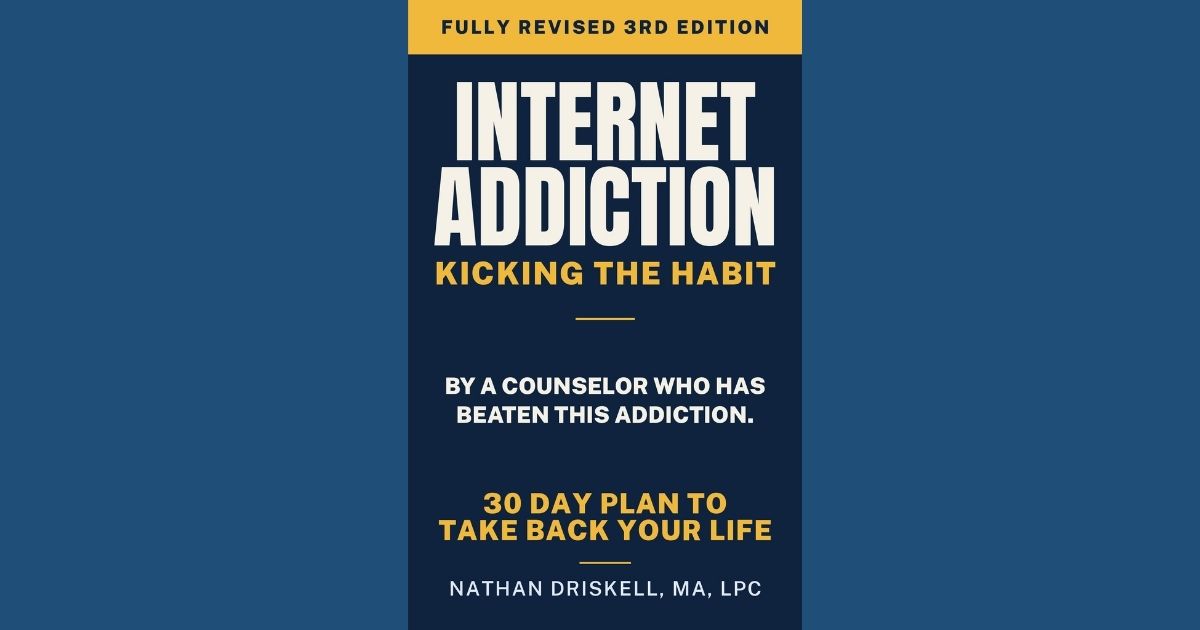
And if you want the full thirty days, the third edition of Internet Addiction: Kicking the Habit is out now — fully revised for phones, feeds, gaming, and the AI companions that did not exist when I wrote the first edition.Thirty days to Change Your Life. Ninety to Keep It. That is the honest version, and it is the only one I am willing to sell.
References
Lally, P., van Jaarsveld, C. H. M., Potts, H. W. W., & Wardle, J. (2010). How are habits formed: Modelling habit formation in the real world. European Journal of Social Psychology, 40(6), 998–1009. https://doi.org/10.1002/ejsp.674
Maltz, M. (1960). Psycho-Cybernetics. Prentice-Hall. [Origin of the apocryphal "21-day rule" — cited for historical context only, not as habit-formation evidence.]

- Why Kids Can’t Stop Playing Roblox — and What Parents Can Do About It - September 16, 2026
- What the Texas App Store Law Changes for Parents - September 2, 2026
- Thirty Days Will Not Cure You - August 26, 2026
Recognize Yourself — or Your Child — In This Article?
Take my free Internet Addiction Self-Assessment to see where the patterns fall on the clinical spectrum. Twenty questions, fifteen minutes, with your results on screen right away. There are two versions — choose the one that fits: an adult assessing themselves, or a parent or caregiver assessing a teen or young adult.
No spam. Your email is only used for the follow-up sequence and my newsletter — your answers on the assessment never leave your browser. Unsubscribe anytime. This is a screening tool, not a diagnosis.