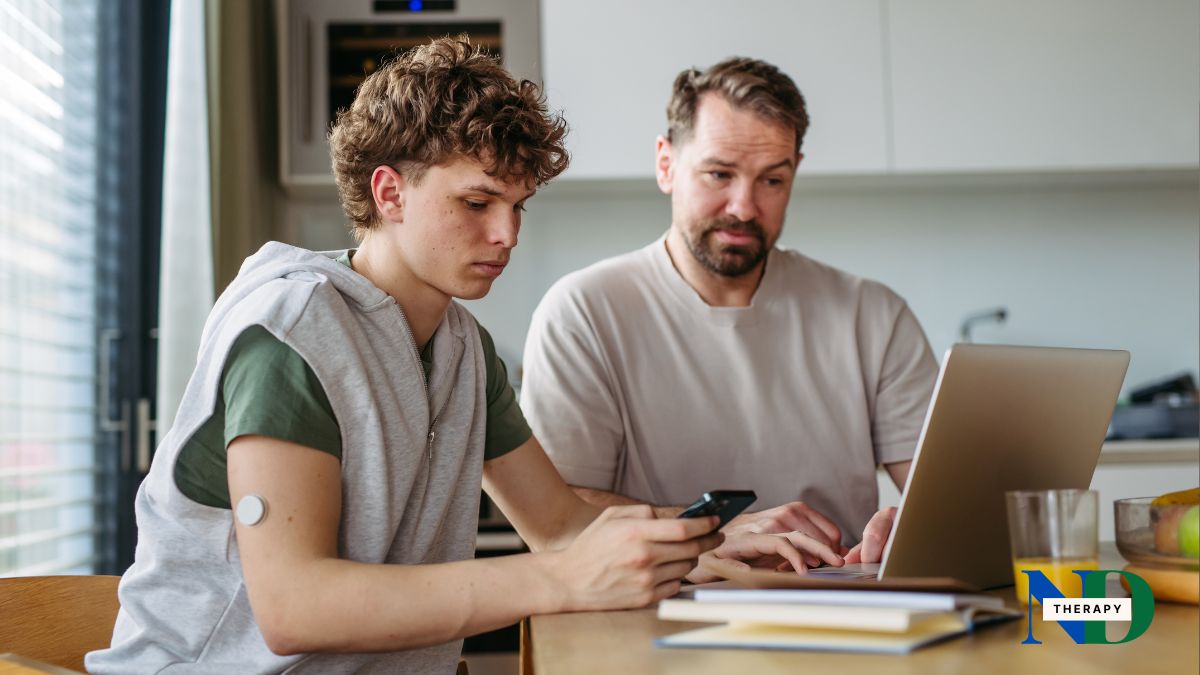
A practical guide for parents of autistic teens and young adults, and for autistic adults planning their own holiday.

For most families, Thanksgiving is a familiar picture: a full table, a crowded kitchen, the game on in the next room, relatives catching up over pie. For many autistic teens and young adults, that same picture is a lot to take in. The noise never stops. The house smells like six things at once. Someone is asking about school, someone else wants a hug, and the plate in front of them holds foods they didn’t choose.
None of this means your teen doesn’t love their family or doesn’t want to be there. It means the day asks a great deal of a nervous system that processes the world differently. The good news is that most of what makes Thanksgiving hard is predictable, and what’s predictable can be planned for.
This guide is written for parents of autistic teens and young adults. I’ll tell you up front: if you’re an autistic adult reading this for yourself, nearly all of it applies to you, too.
Why Thanksgiving Hits Differently When Your Teen Is on the Spectrum
Thanksgiving stacks several of autism’s most common stressors into a single afternoon: sensory load, a broken routine, unstructured social time, and food expectations. Any one of these might be manageable on its own. Together, they compound.
There’s also a hidden cost. Many autistic people work hard in social settings to appear “typical”: forcing eye contact, rehearsing responses, holding back the movements that help them self-regulate. Researchers call this camouflaging, or masking. In a study of 92 autistic adults, Hull et al. (2017) found that camouflaging often led to exhaustion and a need to withdraw from people afterward. A four-hour family dinner can mean four hours of that effort.
So when your teen seems fine at the table and falls apart in the car, that isn’t manipulation or ingratitude. It’s often the bill coming due.
The Sensory Side of the Holiday: Noise, Smells, Food and Touch
Sensory differences are among the most consistent features of autism. A meta-analysis of 14 studies found significantly more sensory symptoms in autistic children than in their typically developing peers, including over-responsivity (feeling sensations too intensely), under-responsivity, and sensation seeking (Ben-Sasson et al., 2009). These patterns don’t switch off at 13 or 18; many autistic adults describe them as lifelong.
Here’s where Thanksgiving tends to press hardest:
- Sound. Overlapping conversations, a TV turned up for football, clattering dishes, kids running through the house, laughter that spikes without warning. For someone with auditory sensitivity, it isn’t background noise; it’s like being unable to turn the volume down.
- Smell. Roasting turkey, sage, cinnamon candles, coffee, and perfume, all at once in a closed-up house.
- Food. Smell, texture, color, and temperature can all drive food selectivity in autistic children (Cermak et al., 2010). In one study, autistic children refused about 42% of the foods offered to them, compared with about 19% for typically developing children (Bandini et al., 2010). A holiday built around a large, unfamiliar, mixed-together meal, with relatives saying “just try one bite,” lands right on top of that sensitivity.
- Touch. Hugs at the door, a hand on the shoulder, stiff dress clothes, a crowded bench at the table.
- Sight. A house full of people moving in every direction, bright overhead lights, decorations and the general visual clutter of a busy kitchen.
Selective eating at Thanksgiving is not a character flaw, and it isn’t a battle worth fighting on the one day when everything else is already hard.
Before You Go: Building a Sensory Plan Together
The most effective planning happens with your teen, not for them. Teens and young adults are far more likely to use a plan they helped build. Sit down a week ahead and walk through the day together.
- Preview the day. Who will be there? When do you arrive, when does the meal start, and when do you expect to leave? If you don’t know, find out. Uncertainty is a stressor of its own.
- Pack a sensory kit. Earplugs or noise-reducing earbuds, sunglasses or a cap for bright rooms, a familiar hoodie, a fidget, or headphones.
- Bring safe foods. A dish your teen reliably eats, brought quietly as “something we’re contributing,” takes the pressure off. No one needs an explanation.
- Choose clothes for comfort. If the family dresses up, find a version of “nice” that doesn’t scratch, pinch, or cling.
- Scout a quiet spot. A back bedroom, a porch, the car. Ask the host ahead of time whether one room can stay quiet for anyone who needs it.
- Agree on an exit plan. Decide in advance what happens if it’s too much: a code word, a text to you, permission to leave early, or a separate car.
If you’re an autistic adult: you’re allowed to build this plan for yourself, and you don’t owe anyone an explanation for any part of it.
At the Gathering: Breaks, Exit Plans and Early Warning Signs
Overload rarely arrives all at once. It builds, and most people show early signs before they hit their limit: going quiet, short answers, irritability, pacing, more stimming, covering their ears, or a sudden pull toward their phone.
- Schedule breaks before they’re needed. A 10-minute break every hour works better than waiting until your teen is already overwhelmed. Walking the dog, running to the store for ice, or “grabbing something from the car” are easy, socially acceptable exits.
- Give them a script. “I’m going to step outside for a few minutes” is enough. They don’t need to explain why.
- Honor the exit plan. If your teen uses the code word, follow through without debate. A plan that only works when it’s convenient for the adults isn’t one they can trust next time.
Why Family Conversation Feels So Hard (and Why It’s Not Just Your Teen)
Conversation is where many autistic teens and young adults struggle most at family gatherings, and it helps to understand why.
For years, social difficulty in autism was framed as something that lived entirely inside the autistic person. Autistic researcher Damian Milton (2012) proposed a different idea, which he called the double empathy problem. It describes a breakdown in mutual understanding between people who experience the world very differently. Autistic people often struggle to read non-autistic people, but non-autistic people struggle just as much to read autistic people. The difficulty runs both ways.
Research backs this up. Crompton et al. (2020) had autistic adults, non-autistic adults, and mixed groups pass a story down a chain of people. Autistic-only chains passed the information along, as did non-autistic chains. The story fell apart fastest in the mixed chains, which also reported lower rapport.
What does that mean at the Thanksgiving table? Your teen isn’t “bad at talking.” They’re in a room where the conversational rules (small talk, vague questions, jokes that depend on tone, topics that jump around) favor a different communication style than theirs. Small talk can feel especially pointless, because it isn’t really about the information being exchanged.
Add the questions relatives love to ask, such as “So, how’s school?” “Seeing anyone?” or “What are you going to do with your life?”, and it’s easy to see why so many autistic teens retreat.
Conversation Tools You Can Practice This Week
Conversation is a skill that improves with preparation, and Thanksgiving conversations are unusually predictable. You can practice most of them ahead of time.
- Prepare answers to the predictable questions. Write down the five questions your teen is most likely to hear, and help them come up with a short, true answer for each. “School’s fine. I’m taking chemistry this year, which I actually like.” That’s enough.
- Have two or three questions to ask back. Most people enjoy talking about themselves. “How’s the new job?” or “Did you travel anywhere this year?” moves the spotlight and lets your teen listen instead of perform.
- Find a bridge to a shared interest. Think about which relatives share your teen’s interests. A cousin who plays the same game or an uncle who loves the same subject can turn a dreaded conversation into the best part of the day. Talk built around a real interest is usually far easier than open-ended small talk.
- Practice a polite exit. “It was good to catch up. I’m going to grab more food.” Knowing how to leave a conversation makes it much less scary to enter one.
- Plan for hard topics. If politics or other heated subjects tend to come up, agree on a neutral line in advance, like “I’d rather not get into that today,” along with permission to walk away.
- Role-play it. Running through a few exchanges at home, even awkwardly, makes them much easier to use under pressure.
It’s also fine for some conversations to be short. A few comfortable exchanges are a better goal than hours of strained small talk.
Preparing the Relatives, Too
Because communication difficulty runs both ways, some of the preparation belongs to the rest of the family. With your teen’s permission, a short message to the host or a few key relatives can head off a lot of friction. Ask your teen first how much they want shared. Some will be comfortable with you mentioning autism; others will want you to stick to practical requests.
Here’s a sample message you can adapt:
“We’re looking forward to Thursday! A few things that will help [Name] enjoy the day: they may step outside for short breaks, they’ll probably bring some of their own food, and they’re more comfortable with a wave than a hug. If they’re quiet, it doesn’t mean they’re upset; they’re just recharging. Asking about things they’re into, like [interest], is a great way to connect with them.”
Most relatives want to get it right. They just don’t know how.
The Day After: Planning for Recovery
The holiday doesn’t end when you pull out of the driveway. Many autistic people need real time to recover after a demanding social day, and that need is genuine.
Autistic burnout is related but longer-lasting. Autistic adults interviewed by Raymaker et al. (2020) described it as chronic exhaustion, loss of skills, and reduced tolerance to stimulus, often brought on when life’s demands outpace a person’s resources over time. The researchers also flagged the risks of teaching autistic people to mask. One holiday won’t cause burnout on its own, but the season stacks events close together: Thanksgiving, then a string of December gatherings.
- Keep the next day clear. No plans, nothing beyond the basics, and as much quiet as possible.
- Expect a lower-energy version of your teen. Shorter answers, more screen time, and more time alone are signs of recovery, not regression.
- Debrief later, not in the car. A day or two afterward, ask what worked and what didn’t. Write it down, so next year’s plan starts with real information.
- Measure success honestly. If your teen came, stayed for part of it, and got home without a meltdown, that’s a win, even if they spent half the afternoon on the porch.
If the exhaustion, withdrawal, or loss of everyday skills lasts well beyond the holiday, that’s worth paying attention to.
When to Reach Out for Support
Sometimes holiday stress is a window into something bigger: ongoing anxiety around family, a teen who is masking all day at school, signs of burnout, or a young adult who keeps pulling further away. Those are all good reasons to talk with a professional who understands autism.
I work with autistic teens and adults, and with parents of teenagers, through teletherapy across Texas, with afternoon and evening appointments available. If you’re wondering whether your teen (or you) might be on the spectrum, the free Autism Traits Reflection Tool on my website is a good place to start. It isn’t a diagnosis, but it can help you organize what you’re noticing. For autistic adults, my book So You Have Autism, Now What? offers a practical 30-day framework you can work through at your own pace.
Thanksgiving doesn’t have to look like the picture to be a good day. It just has to work for your family.
References
Bandini, L. G., Anderson, S. E., Curtin, C., Cermak, S., Evans, E. W., Scampini, R., Maslin, M., & Must, A. (2010). Food selectivity in children with autism spectrum disorders and typically developing children. The Journal of Pediatrics, 157(2), 259–264. https://doi.org/10.1016/j.jpeds.2010.02.013
Ben-Sasson, A., Hen, L., Fluss, R., Cermak, S. A., Engel-Yeger, B., & Gal, E. (2009). A meta-analysis of sensory modulation symptoms in individuals with autism spectrum disorders. Journal of Autism and Developmental Disorders, 39(1), 1–11. https://doi.org/10.1007/s10803-008-0593-3
Cermak, S. A., Curtin, C., & Bandini, L. G. (2010). Food selectivity and sensory sensitivity in children with autism spectrum disorders. Journal of the American Dietetic Association, 110(2), 238–246. https://doi.org/10.1016/j.jada.2009.10.032
Crompton, C. J., Ropar, D., Evans-Williams, C. V. M., Flynn, E. G., & Fletcher-Watson, S. (2020). Autistic peer-to-peer information transfer is highly effective. Autism, 24(7), 1704–1712. https://doi.org/10.1177/1362361320919286
Hull, L., Petrides, K. V., Allison, C., Smith, P., Baron-Cohen, S., Lai, M.-C., & Mandy, W. (2017). “Putting on my best normal”: Social camouflaging in adults with autism spectrum conditions. Journal of Autism and Developmental Disorders, 47(8), 2519–2534. https://doi.org/10.1007/s10803-017-3166-5
Milton, D. E. M. (2012). On the ontological status of autism: The “double empathy problem.” Disability & Society, 27(6), 883–887. https://doi.org/10.1080/09687599.2012.710008
Raymaker, D. M., Teo, A. R., Steckler, N. A., Lentz, B., Scharer, M., Delos Santos, A., Kapp, S. K., Hunter, M., Joyce, A., & Nicolaidis, C. (2020). “Having all of your internal resources exhausted beyond measure and being left with no clean-up crew”: Defining autistic burnout. Autism in Adulthood, 2(2), 132–143. https://doi.org/10.1089/aut.2019.0079

- Thanksgiving on the Spectrum: Managing Sensory Overload & Family Conversation - November 10, 2026
- Why Kids Can’t Stop Playing Roblox — and What Parents Can Do About It - September 16, 2026
- What the Texas App Store Law Changes for Parents - September 2, 2026
Could I, or My Child, Be Autistic?
Take my free Autism Traits Reflection Tool to see if a formal Autism diagnosis is recommended. About twenty questions, fifteen minutes, with your results on screen right away. There are two versions — choose the one that fits: an adult reflecting on themselves, or a parent or caregiver reflecting on a teen or young adult.
No spam. Your email is only used to send your results guide and the short follow-up sequence, and you can unsubscribe anytime. This is a reflection tool, not a diagnosis.