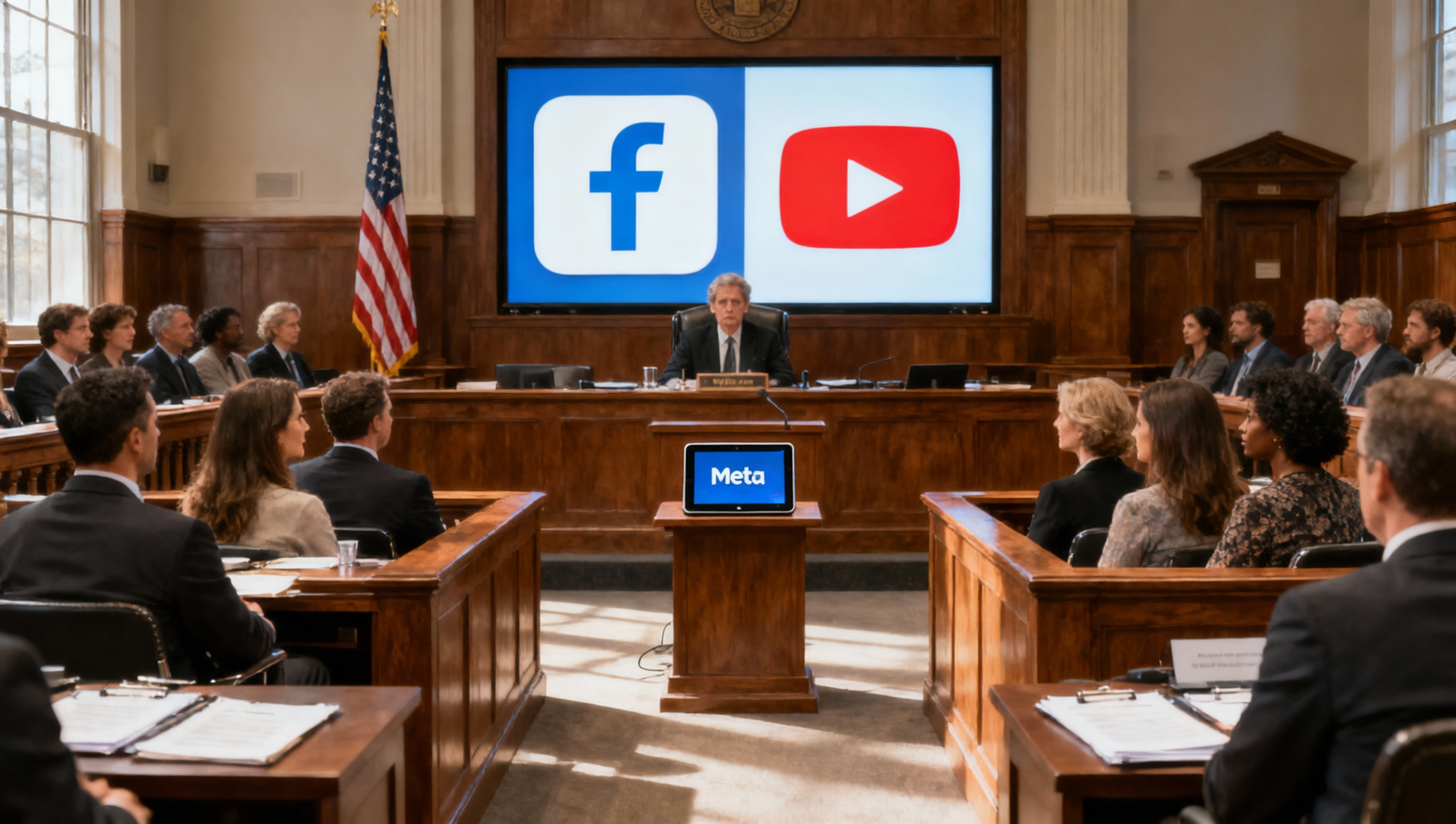
In a landmark decision that reverberated around the world, a Los Angeles jury on March 25, 2026, found Meta and Google’s YouTube legally liable for deliberately designing their platforms to addict children, awarding damages to a 20-year-old plaintiff known only by her initials, KGM. The verdict, covered extensively by ABC Australia and news outlets globally, is being called the social media industry’s “Big Tobacco moment” — the point at which the courtroom finally catches up with what parents, educators, and mental health professionals have been saying for years. For families everywhere, and for countries like Australia that have already taken legislative action against social media for children, the implications are enormous.
The Case and the Verdict
At the center of the Los Angeles trial was KGM, referred to throughout the proceedings as “Kaley.” KGM testified in February that her early use of social media triggered her addiction to the technology and exacerbated depression and suicidal thoughts. She said she had developed body dysmorphia — a clinical condition diagnosed by doctors — as a result of her social media use. She began using YouTube at age 6 and Instagram at age 9.
After more than 44 hours of deliberations over nine days, the jury found Meta and YouTube negligent in the design or operation of their platforms and determined that their negligence was a substantial factor in causing harm to the plaintiff. The jury also concluded that both companies failed to adequately warn users of the dangers of their platforms. NBC News: The jury found Meta 70 percent responsible for the harm and YouTube 30 percent, ordering a total of $6 million in damages — $3 million in compensatory damages and $3 million in punitive damages.
How the Platforms Were Designed to Hook Children
The legal strategy used by KGM’s attorneys proved decisive. Rather than focusing on the content children see on social media — an approach that would run into Section 230 protections — the plaintiff’s team placed the spotlight squarely on platform design. Meta’s apps, including Instagram, and Google’s YouTube, were found by the jury to have been deliberately built to be addictive, and the companies’ executives knew this and failed to protect their youngest users.
The lawsuit alleged that the companies, borrowing heavily from the behavioral and neurobiological techniques used by slot machines and exploited by the cigarette industry, deliberately embedded in their products an array of design features aimed at maximizing youth engagement to drive advertising revenue. These features — including infinite scroll, autoplay video, algorithmic recommendations, and push notifications — were presented as engineered tools of addiction rather than incidental design choices.
Meta CEO Mark Zuckerberg and Instagram head Adam Mosseri both testified during the trial. Zuckerberg insisted that user safety has always been a company priority, while Mosseri pushed back against the concept of social media addiction during his own testimony. The jury was unconvinced.
Back-to-Back Verdicts Signal a Turning Point
The Los Angeles decision did not arrive alone. Just one day earlier, a New Mexico jury found Meta liable for violating that state’s consumer protection laws and enabling child sexual exploitation on its platforms, ordering the company to pay $375 million in civil penalties. The back-to-back verdicts show the public’s growing willingness to hold the companies responsible for harms and demand meaningful changes in how they operate.
Both Meta and YouTube have stated they disagree with the verdicts and plan to appeal. A Meta spokesperson said that teen mental health is profoundly complex and cannot be linked to a single app, while YouTube’s statement argued the case misunderstands YouTube as a responsibly built streaming platform, not a social media site.
What This Means for Australia and the World
Australia has been at the forefront of child protection legislation in this space. In December 2025, Australia became one of the first countries to ban people under 16 from social media, with other countries now considering similar restrictions. Since the Australian ban, social media companies have revoked access to approximately 4.7 million accounts identified as belonging to children.
The Los Angeles verdict gives significant legal weight to the reasoning behind that legislation. If American juries are now confirming through the courts what Australian lawmakers concluded through legislation — that these platforms are deliberately designed to harm children — it validates the case for strong, enforceable child protection policies worldwide. This case is now being compared to the legal crusade in the 1990s against Big Tobacco, which forced the industry to stop targeting minors with advertising. The parallels are difficult to ignore.
Thousands More Cases Are Waiting
This was the first trial in a much larger consolidated case involving more than 1,600 plaintiffs seeking to hold social media companies responsible for the harm they suffered from using those products. The Oakland federal trial involving school districts is still to come, with the first bellwether case scheduled for the summer of 2026. Each verdict against the platforms increases pressure for industry-wide settlements and potential legislative reform.
Takeaway
For parents, the verdict in Los Angeles is both validating and sobering. It confirms through a jury of twelve ordinary citizens what many families already know in their bones: that these platforms were not accidentally addictive. They were engineered to be. The mental health crisis unfolding in children across the world — the anxiety, depression, body dysmorphia, and suicidal ideation — is not a coincidence. It is, at least in part, the predictable result of deliberate design choices made by some of the most profitable companies in human history. Australia’s decision to act legislatively is now backed by a legal verdict. The question for every other country, every school, and every family is the same: how long are we willing to wait before we do the same?
Source: Read the Original Article

You can reach me at my website or call me directly at 832-559-3520 if you have any questions. Thank You!
- Social Media’s Big Tobacco Moment Has Finally Arrived - March 26, 2026
- Big Tech Faces Children’s Addiction Claims in Court - March 23, 2026
- New Autism Treatment Targets the Gut, Not the Brain - March 18, 2026